Being found is no longer enough — AI has to understand why you matter.
15/09/2026Amsterdam 2026AIE‑commerce
The panel explores how e-commerce changes when AI systems increasingly discover, compare and select products — and why structured data, trust signals and clear added value become essential for staying visible and being chosen.
Comment onYouTube (opens in a new window)
PanelOriginal language: Dutch
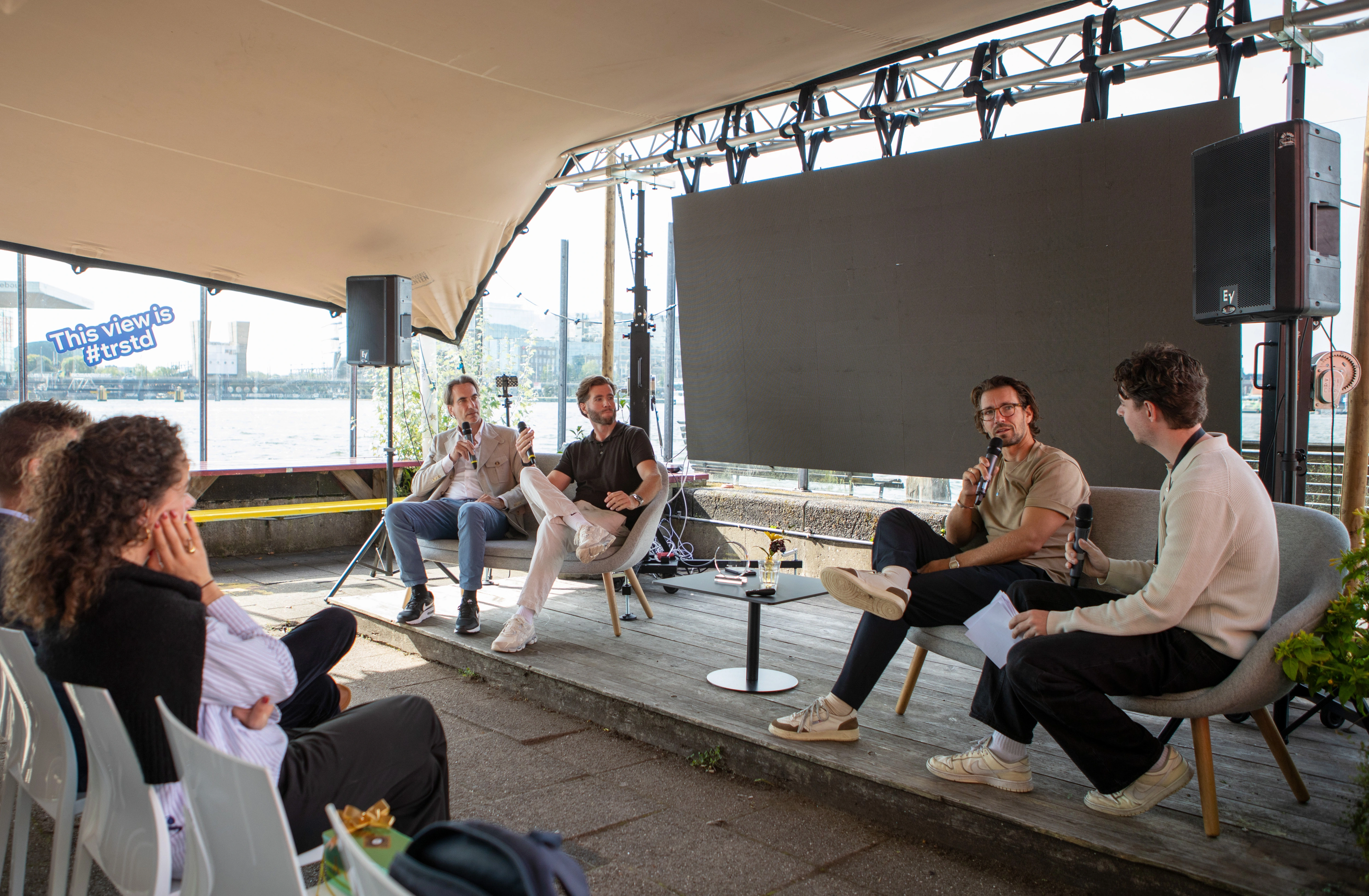
On stage: Industry expert panel
Transcript
# Expert Panel: From SEO to GEO — The Next Era of E‑Commerce — #trstd connect Amsterdam
Roy Maljaars: We've already looked at this from a number of different angles and talked about where AI is changing things.
One of the topics that is obviously very relevant for us at Trusted Shops is that we've entered an age of fakes. A lot is changing around trust and the influence AI has on it, and that affects the entire customer journey.
What we thought would be particularly interesting is to break that down: how AI is changing the way products are discovered, understood, selected and purchased in e‑commerce; what that means for customer service; and, finally, what the changing role of agencies is when they work with online shops.
We've put together a panel I'm very happy with.
Let's start with Yannick. Happy Horizon and Trusted Shops have been working together for quite some time. Yannick, could you briefly introduce yourself, explain what you do at Happy Horizon and what Happy Horizon does for online shops?
Yannick Roling: Thank you. I'm Yannick. I've been active in e‑commerce for about 12 years now. I originally came from the wholesale and manufacturing side and eventually moved into e‑commerce. At the time, that was mainly B2B, but over the years it became broader.
At Happy Horizon, I'm responsible for our technology partnerships. We work with around 80 different companies across everything we do — e‑commerce platforms, PIM, and really almost everything you encounter in this space. Somewhere in the organisation we usually have a specialist or a customer working with it.
Happy Horizon now has around 600 people across seven locations. We basically work across the whole customer journey, from the very beginning through to purchase and then retention.
Roy Maljaars: Great. Thanks, and great to have you here.
Michel, you're the founder or co-founder of H1 Webdevelopment. Around 2006, if I've got that right?
Michel Willems: I'd have to do the maths, but about 21 years ago.
Roy Maljaars: A lot has happened at H1 in the last couple of years as well. We also organised an event together in May. Michel, could you briefly introduce yourself and explain what you do at H1?
Michel Willems: I'll keep it short. I'm a co-founder, which means you do a bit of everything, but my main focus is commercial.
We're around 40 people. We build webshops, integrate systems and implement PIM systems. Since November, we've been part of a larger group. There are also colleagues from the same group here today, including BigBridge.
The reason I'm on this panel is that I'm spending a huge amount of time on GEO and agentic commerce. Some of what has already come up today is exactly what we're working on, and we'll probably summarise some of that again in a moment.
Roy Maljaars: Great.
And last but not least, Ludo. You've been working at Salesupply for more than ten years. Salesupply and Trusted Shops go back quite a long way as well. Could you briefly introduce yourself and explain what you do?
Ludo: Thank you. My name is Ludo. I've been with Salesupply for about ten years now.
From the Salesupply side, we approach e‑commerce from a very different angle from many of the service providers we've heard from today. We provide customer service and logistics for online shops.
Our headquarters are in Nijmegen — a city that has come up quite a few times today. Our founders are from there. But we now have our own locations in the 15 largest European markets, as well as in China and the United States.
We started in the Netherlands, helping Dutch online shops expand internationally. From there, it grew into cross-border support in all directions: French shops entering Germany, American shops entering Europe, German shops entering America, and so on.
On the logistics side, we help Dutch shops and brands distribute products all over the world. It can also be a company that handles its own logistics in Europe but wants to establish a foothold in the US. We can hold the products locally and ship them from there.
On the customer-service side, a huge amount has changed because of AI over the past few years. AI is disrupting e‑commerce in general, but customer service in particular. I have a few good examples and customer cases around that.
Roy Maljaars: Great. First of all, thanks to all of you for joining.
Let's start at the beginning of the customer journey, from the consumer's perspective: discovering products.
Traditionally, people searched through Google. That's changing rapidly.
Yannick, let me start with you. From your perspective, how is the way consumers discover brands and products changing?
Yannick Roling: If you believe Gartner, there won't be any webshops left in a few years and nobody will visit a webshop anymore.
Gartner does make bold statements from time to time.
But what has already been mentioned today is that discovery is becoming much more intent-driven. It's becoming more of a dialogue with a chatbot. And the longer you use that chatbot, the better it gets to know you. The advice becomes more personal.
As a business, that means you need to understand your product extremely well so you can expose the right product data.
There are still limitations. At the moment, you may only have a limited number of fields you can feed into certain systems, so within those fields you need to express the intent and the things that actually matter.
We're still extremely early in this whole journey. We can't yet see exactly where it will lead.
But in many ways, it comes back to the basics: know your product, know your customer, know what differentiates you, and make sure you translate that into data.
In that sense, not that much has changed. Companies still have too little useful data. They still combine too little of the data they do have.
Data was important before, it's important now, and it will remain important. What's changing is that more tools are appearing that may remove part of the human role, especially in agentic commerce.
Roy Maljaars: If you compare that with how much people still use Google today, what do you expect the relationship between Google and large language models to look like in, say, four or five years?
Yannick Roling: It will increase, but predicting the exact ratio is really reading tea leaves.
I expect the share of AI-driven discovery to grow, because it's already larger than it was two years ago.
Will Google disappear completely? Will AI take over everything? I'm not going to make that prediction.
Roy Maljaars: Fair enough.
Maybe a difficult question for the others as well. Do you expect that a company could rank number one in Google but not be visible in ChatGPT, or the other way around?
Michel?
Michel Willems: The two are closely related.
One advantage Google has is that Google itself is a major AI player, so Google probably isn't going to disappear.
SEO and GEO are actually very similar. There are a few things that are new or slightly different.
But you've probably already seen this with your customers: if a business is found well in Google, it is often also recommended by ChatGPT.
If you're found well in Google, you probably have your data in order. You may already have proper schema saying: this is an FAQ, this is a product, this is a price.
If you don't have that properly structured, you probably aren't doing as well in Google either.
The difference is becoming even more important now.
The main difference in the interface is that people no longer have to click through ten results and draw the conclusion themselves. The same underlying data can now be interpreted and summarised by a large language model, whether that's Google's model or ChatGPT.
Roy Maljaars: Given the audience, let's not go too deeply into the technology.
But you already mentioned a few examples. If you want a product, a brand or a webshop to be discovered and understood, what are the crucial elements that a system needs to be able to read from the webshop?
Michel Willems: Fundamentally, you need to explain to the machine what is on the page.
Your schema needs to be in order. Schema.org tells the machine: this is an FAQ, this is a price, this is a product description, and so on.
You shouldn't make the site readable only for humans. You need to make it readable for machines as well.
You can do that with schema.org and with good feeds.
E-commerce platforms such as Shopify are working very actively on making this kind of data available themselves. On platforms such as Magento, you have agencies and the community building that layer.
So, in simple terms: make your information machine-readable.
One very practical thing you can do is look at your website from the machine's perspective in the browser and see what it can actually read. That already gives you a decent indication.
Roy Maljaars: Are you already implementing this for H1 customers?
Michel Willems: Absolutely.
Some of these things we were already implementing because, again, they were part of SEO.
Then there's the feed side. Most webshops already have feeds for Google Shopping and similar services. Now additional feeds are being added for AI-driven environments.
And if you approach that properly, we do see results.
There is one customer, Duijvestein Winterstore, where I am not allowed to share the exact percentage increase. I messaged them this morning to ask.
They basically said: "There will be suppliers and competitors in the room, so let's keep that number confidential."
But the results are very good. After making a few relatively small changes, they are selling significantly more skis and clothing, and they are getting more visitors with strong purchase intent.
Roy Maljaars: Can you name one crucial thing you changed that made a difference?
Michel Willems: There were many small changes, but the most important one is probably the feed.
Another example I can talk about freely is our own website.
For the people in the room who build webshops, you can take this one home with you: since we started adding FAQ sections to all our blog articles, the number of leads coming through ChatGPT and other LLMs has risen.
Until recently, roughly one in four leads came via ChatGPT. Now it's around 30 to 40%.
And the difference was those FAQs.
So that's something you can start doing tomorrow.
Roy Maljaars: Or everyone could leave it for a while and let you keep the advantage.
Another question about the "understanding" part.
Do you think we're going to reach a point where websites and webshops are developed primarily to be readable by AI agents, with less time spent on look and feel for consumers?
Michel Willems: That's an interesting one.
Yannick already mentioned Gartner saying that websites will disappear. The Gartner research I've seen suggests something closer to 30% becoming machine-driven, which still leaves 70%.
You shouldn't forget that 70%.
I think highly rational purchasing processes will be the first to be outsourced.
If I need a specific brand of dog food tomorrow and I want the cheapest supplier, that's an obvious task to delegate.
In B2B, lots of purchasing is already automated through ERP systems, EDI, punchout integrations and similar systems. Those types of processes are probably the first to move towards agents.
But there are still emotional decisions.
Some people genuinely enjoy shopping.
In those cases, we'll use AI differently. We'll use AI to make the shopping experience better.
There are already examples where a frontend can adapt very easily to different shopping experiences.
Take the same backpack. You can present it differently to someone whose intent is trail running versus someone who wants it for a relaxed walk with their children.
You can change the photos, the design and the way the story is presented.
As agencies, we can produce these experiences much faster now.
Today, we still design those experiences ourselves based on intent. We may be getting close to the point where they can be generated dynamically on the fly.
I don't yet have a live customer example of that. Maybe someone in the room does. But that's probably where we're heading.
Roy Maljaars: It could get expensive if you're generating everything dynamically.
Michel Willems: Yes. I can already see the token bill coming in.
And then you have to compare that cost with the conversion it generates.
But the point is this: suppose Gartner is right and 30% of existing traffic disappears. If you don't adapt and simply lose 30%, many businesses will become unprofitable.
When the internet arrived, entire sectors disappeared. Think of the traditional travel agency on the high street.
They might still have retained 80% of their old turnover for a while, but that wasn't enough to support the same physical infrastructure.
So you absolutely need to get the machine-readable part right.
But that does not necessarily mean that 70% of purchases will be made by agents in the near term.
Yannick Roling: A few years ago, people also said there wouldn't be any new webshops because you could buy everything on marketplaces like bol.com.
In the end, marketplaces simply became another sales channel.
At the beginning, businesses did wonder whether new standalone stores would still make sense.
A website or webshop isn't going to disappear completely, because brands also use their own site as a place to show who they are, even if the webshop itself isn't always the main revenue generator.
That brand experience still matters.
For many brands, a lot of revenue also still happens in physical stores.
So the website remains relevant, but there is a new sales channel emerging.
And there will be some cannibalisation if you're not visible in that AI channel.
Roy Maljaars: Exactly.
Let's move to the point where a choice is actually made.
Yannick, perhaps one for you.
When a website or webshop is being read by an agent, what are the elements that determine which webshop is chosen over a competitor, apart from the technical points we've already discussed?
Yannick Roling: I think the trust element that Trusted Shops is working on is going to be very important.
As a human, I can see a website, recognise Trusted Shops and think: okay, that looks legitimate.
I'm obviously a little more familiar with the signal than someone who doesn't know the brand.
An agent has no emotion about it. It will try to collect evidence: how many points of confidence can I gather about this website?
One shop may have more verifiable signals than another, and the agent will simply factor that into the decision.
That was also why I found the fake-shop discussion so interesting.
With AI, things that used to require a huge amount of effort can now be created very easily.
We were recently talking about books. People can generate complete books with AI, full of nonsense, actually have them printed and published, sell them, and then buyers return them because they realise it isn't really what a proper author would have produced.
The same thing happens with fake websites.
So the trust signal you add to a site will become more important.
Beyond that, relevance still matters.
The product data needs to be correct and sufficiently detailed.
Imagine a backpack. Maybe one person wants only two compartments because they want something simple. Another person is going on a long hike and wants separate compartments because they like structure.
Different people care about different attributes.
So publish as much useful product data as possible so the customer can make the right choice — and so the agent, which has less emotion than you do, can make the right choice as well.
Roy Maljaars: Ludo, how do you look at that from a logistics perspective?
Are there logistics-related factors that help a brand get selected before the purchase takes place?
Ludo: Absolutely.
Our playing field is international, so you have to think beyond the Netherlands.
With AI, borders are becoming less relevant than ever. Shops can potentially sell into many different countries.
We work with examples like K-Parts, where you see rapid international expansion.
Imagine you start offering the same product in Italy, France or Spain.
Assuming the basic proposition is already in order, what do you choose between suppliers?
Whether it's a human or an AI making the decision, if your shipping cost is twice the market norm and the delivery time is much longer, that's a conversion killer.
So the basics of international commerce remain very important.
You need to be able to deliver to customers across Europe within a few days, at competitive shipping rates.
That is possible, but many individual merchants can't negotiate those rates themselves. You often need large carrier contracts. There are providers in the market that allow you to benefit from their scale.
Then there is customer service.
AI can automate a lot, and I'm sure many people in this room have examples.
You see agencies claiming 80% automation. Often, that works particularly well for simple categories of questions such as "Where is my order?"
But look at a business like K-Parts. They get much more technical questions. You're not going to achieve 80% fully autonomous resolution there yet.
You still need people.
And if you're entering a foreign market, you may have those people in the Netherlands, but how do you provide that same support in another country?
That's why a hybrid model remains crucial if you want to maintain trust.
Of course, you could keep everything digital and automate it all. But once a purchase happens, that experience creates a review.
The real question is what happens when something goes wrong. That's when the consumer forms an opinion, and those reviews become extremely important, particularly in a new market.
Roy Maljaars: Do you also think AI is making it easier for your customers to open new markets because an agent can suddenly give them access?
Ludo: More than ever.
If we really wanted to, we could probably spend this afternoon putting the basics of Poland in place for some webshops.
You also have marketplaces, your own shops, social strategies and other channels.
Ten years ago, I would sit with companies for a full market study about Germany or France and then develop large implementation strategies.
Today, everything moves much faster.
Many webshops already ship to 20 countries or more.
The interesting question becomes: which markets do you actually want to take seriously, perhaps because you want to become a market leader there?
Then you need depth.
And the fundamentals are still very simple: fast delivery, the right commercial conditions, competitive shipping, good carriers and good customer service.
That closes the loop with reviews.
If you create good experiences, you build good reviews, and those reviews then become visible again in the search process of AI agents and consumers.
That creates the trust to buy.
Roy Maljaars: Before we go deeper into customer service, let's step back to the purchase itself.
This question came up earlier this morning.
Based on the way you work with customers and what you're seeing in the market, when do you expect people to start authorising agents to actually complete checkout on webshops?
Michel?
Michel Willems: As soon as it is made available in Europe, the first transactions will happen.
And what Ludo just said becomes even more important then.
Those rational criteria will become very visible.
If you're selling in Italy, being able to deliver within one or two days at market-level rates becomes a real decision factor.
Roy Maljaars: Yannick, do you have a view on when agents will actually be checking out on shops?
Yannick Roling: I agree with Michel.
The moment it is released, it will start happening.
The question is when that release comes.
Right now you hear two different narratives in the news.
One is: we need to slow down and add more regulation. Do we really want all of this?
The other possibility is that, after looking at it, the market suddenly decides that it can simply be rolled out.
I do think it will still take some time before agent-led checkout becomes completely normal.
Michel Willems: That's what happens with every new technology. It moves in fits and starts.
Last year Shopify was saying: we've got the deal, everything is coming, we'll have this across Europe by the end of the year.
Then two or three weeks later, the message changed and things were put back in the fridge.
But it will come eventually.
Roy Maljaars: Exactly.
And when it does, Ludo, you can probably already answer the next question because you're already seeing a lot of this.
What happens with AI after the purchase, in customer service and customer experience?
Ludo: After purchase, the process is completely different from presales.
And what you do depends heavily on the brand.
We have extreme price-fighter brands where we're explicitly asked to spend as little as possible on customer service.
At the other end of the spectrum, we support high-end fashion brands with average order values around €1,000, where the customer may need real product advice for a gala — for example, someone buying shoes and wanting a matching handbag.
I think what we're seeing now is that AI agents in customer service are becoming better and more intelligent, and automation is increasing.
Today, a genuinely good autonomous customer-service agent that can resolve a very high percentage independently is still the exception.
In a few years, I think the opposite may be true.
Then it may become a differentiator — even a USP — if your shop still provides excellent human advisers.
That might sound strange, but the human interaction could become the special experience precisely because everyone else is automating.
As far as I know, AI still doesn't fully replicate empathy and genuine human contact.
And we are seeing trends in that direction.
But it always has to match your brand and your objectives.
There are many different models to choose from.
Roy Maljaars: You mentioned Tory Burch earlier as an example of a brand that differentiates itself through service.
Ludo: Yes.
Large American fashion brands often come to Europe thinking: we'll just launch Europe.
Then they discover that Europe is made up of different cultures, languages and expectations, and it doesn't work as simply as they imagined.
They can still become successful here, but service becomes part of that.
For some of these brands, the people working in customer service are required to have at least three years of retail experience.
They do video calls with customers.
They get to know the customers, because there is a lot of recurring business.
For those brands, they would rather we spend 30 minutes with one customer than say: hang up, the next customer is waiting in the queue.
That's an example of creating an extremely strong customer experience.
And of course, that works because there is enough margin in the business model.
Around 80 to 90% of our customers are in e‑commerce, which is where we came from.
But we also work in other sectors.
One interesting example is e‑mobility and EV charging infrastructure.
We supported a major player that had acquired charging networks from companies including Shell.
At first, we had a lot of real human customer-service staff taking calls whenever a charging point wasn't working or another issue occurred.
When you have a large charging network and multiple acquisitions, there are a lot of support cases.
Then an investor came in and said: we need to reduce costs.
And not just a little.
The instruction was basically: move everything to voice AI.
From our e‑commerce perspective, we said: can we perhaps still do half of it with humans, or at least provide an escape route?
The answer was no: 100% voice.
By now, around 20 to 30% has moved back to humans — but only after the customer has sometimes spent ten minutes in the queue.
That's a very different situation from e‑commerce.
In that case, the customer has already bought into the service and is unlikely to leave immediately.
If some of your customers in this room have subscription-type models, you could imagine similar strategies there.
We've also come quite far with voice AI.
But in e‑commerce, I currently see it realistically resolving around 20 to 30% of cases.
And when it doesn't work, you need a very good customer-service employee immediately.
We call it first-call resolution: someone who can actually solve the problem there and then.
Roy Maljaars: Very interesting.
Before the last question, one topic I'm still curious about from all three perspectives is loyalty.
Loyalty has traditionally been built around interaction with the consumer and giving the customer something back because they buy from you.
What happens to loyalty if the agent increasingly becomes your customer?
Michel, how do you see that developing?
Michel Willems: You get the same split I mentioned earlier.
For one part of the market, the agent needs to become "loyal" to you.
And you achieve that through hard facts.
You need good customer service, strong reviews, the right price, short delivery times — all the criteria that matter in the decision.
If you consistently score well on those factors, the agent effectively becomes loyal to you.
There's very little emotion involved.
The reviews may contain emotion, of course, but the agent is still processing them as evidence.
Then there is the other side: emotional purchases.
Sometimes that's a 30-minute advice conversation.
Sometimes it's something like: my father always wore this aftershave, so this brand reminds me of him.
And there's everything in between.
That's still a very large category.
Some brands may only need one of those groups, but they still need to be discoverable or they'll lose a percentage of the market.
Other brands can focus almost entirely on rational buying criteria and win that segment.
A price-focused retailer can simply offer a perfectly good screw at a very low price, delivered tomorrow.
Roy Maljaars: Ludo, loyalty today is also driven heavily through channels like email marketing.
Do you expect that to change, perhaps with human touchpoints becoming more important again?
Ludo: It depends enormously on the type of webshop.
A K-Parts and a premium fashion brand have completely different strategies.
But from the outside, one thing I see is that everything increasingly becomes a kind of social proof.
We're all being rated through reviews.
And the AI agents that will buy for you will probably also be rated by you on the quality of their purchase.
Was the purchase good or not?
If it wasn't good, the agent learns from that.
So I don't think we'll initially allow agents to operate completely autonomously without feedback.
We may let them act, but we'll still evaluate what they did.
And that evaluation could become very strict.
If a purchase was bad, the agent may simply be instructed not to buy there next time.
Roy Maljaars: Exactly.
Let's move to the last question.
Most people in the room work at agencies.
If we fast-forward three to five years, where do you still see the distinctive role of an agency?
Yannick, let's start with you.
Yannick Roling: At the most basic level, an agency supports an entrepreneur in areas the entrepreneur doesn't master or doesn't have enough knowledge of.
That role keeps changing.
Eight or ten years ago, being able to program was a very specific skill.
It is still a skill today, but the actual production of code can increasingly be done by AI, and in some cases AI may even produce parts of it better.
AI will be used more and more.
But AI isn't free either.
We often get the question: "But don't you do everything with AI now?"
Yes, but I still need to invoice for what it costs to generate, validate and implement those things.
Ultimately, an agency also helps a customer understand their own business.
A company may have been operating for years, or a new management team may come in and forget the fundamental questions: who are we again? Why did we build this product? Why does anyone buy it?
There will always be room for advisers who help answer those questions, think along with the customer, and translate the answers into the right solution — or select an existing solution if someone has already built one.
Roy Maljaars: Michel, how do you look at it?
Michel Willems: It's a fun time. I get a lot of energy from it.
Of course, it's also exciting.
Everyone who runs a technical agency has probably had a customer send them a piece of code that was just generated by Claude and say: "Can you implement this?"
Then you look at it and think: no, we can't just put that into production.
In the AI world, you get a lot of very bad code and some extremely good code.
The difference often comes down to the person who writes the prompts and, even more importantly, the person who can evaluate the output.
That's why I actually think dependence on people with real experience is increasing.
At the same time, it may become harder for juniors to grow into that experience unless they're exceptionally strong.
At the core, it comes back to what Yannick said.
As an agency, you need to focus on areas that are genuinely difficult for the customer.
If you think AI itself is the threat, then for the next few years you're probably focusing on the wrong skill.
AI will simply be part of what all of us do.
And that isn't going away.
Roy Maljaars: Ludo, let's finish with you.
How do you see it?
Ludo: Before answering, there's an interesting point because Yannick just said that AI isn't free.
I have a good example.
A voice bot that fully handles a customer-service call and resolves the entire conversation autonomously is, at the moment, roughly 50% cheaper than using a human customer-service employee.
I would have expected the savings to be much bigger.
You'd think: it's fully automated, every call is handled by bots, so it must be almost free.
But it isn't.
The token costs still consume real money.
So AI is definitely not free yet.
When ChatGPT came out around three years ago, we went all in.
We created multiple AI teams and put smart groups of people on it.
Then, when newer models became genuinely useful for production work, two years of internal development could suddenly be overtaken in a month.
That's how quickly the technology can move.
So if you look ahead, you hear stories that can sound either frightening or exciting, depending on your perspective.
We're still at the beginning.
The most extreme version I can imagine is almost completely automated customer service.
What remains then is a hybrid model.
That's what we already do today.
Often the split is around 50/50, and the share of automation will keep increasing.
But then the question becomes: what does the market want, and what does your brand want?
Maybe real human service becomes the USP again.
On the logistics side, the work is still highly physical.
In e‑commerce, it's still about the best rates, fastest delivery times and best carriers.
I don't think that physical part is going to disappear any time soon.
Roy Maljaars: Great.
Before we open it up to questions, I'd like to thank all three of you for coming and taking part in the panel. I hope we've been able to give people some useful insights.
Are there any questions from the audience?
Jürgen?
Jürgen: One thing feels slightly underexposed to me, and I'm curious what you think.
I think we all agree that a bot will at least partly decide where to buy based on hard criteria.
One of those criteria could simply be the review rating.
If that's true, doesn't it also mean that the role of many webshops as they exist today may disappear?
A lot of webshops are essentially intermediaries between the manufacturer and the consumer.
Should agencies perhaps be focusing much more on the supplier or manufacturer that actually owns the production process?
How do you see that?
Michel Willems: I remember exactly the same question being asked 20 years ago.
That makes me feel old.
E-commerce suddenly allowed manufacturers to approach consumers directly.
And what happened?
A lot of direct-to-consumer brands emerged, or manufacturers started doing part of their business direct to consumer.
So part of the market did change.
But apparently retailers still added value in many cases.
Audience member: Because it was difficult.
Michel Willems: Exactly — because it was difficult.
The question is what happens now that it's becoming easier.
If you're a retailer, intermediary or importer and you still want to be relevant, you need to ask: many things are changing, but what isn't changing?
When you want to understand an innovation, it's often useful to look at what doesn't change.
Consumers still want the right price.
Depending on the situation, they want delivery at the right moment — maybe immediately, maybe in a week if they're not home.
In many cases they want variety and choice.
That's one of the things Amazon has always understood very well.
So there are a number of fundamental factors.
If your business can score well on those factors, in whatever way, an agent will be able to recognise that value.
Take a Chinese manufacturer.
They may be able to offer an extremely low product price because so many products are manufactured in China.
But what they probably cannot easily offer here — unless they outsource it to a company such as Salesupply — is same-day delivery.
They may also be less capable of combining that product with several other products in one order, reducing the overall shipping cost.
So for every customer need and every bundle of requirements, you have to ask: can I still offer additional value?
That's what it comes down to for the webshop: added value.
It won't always be easy, but I think there are opportunities.
There is also the emotional side.
If I'm emotionally invested in a product, I may consciously buy something from a specialist retailer because I like the story, I can touch and try the product, and I receive proper advice.
Maybe I could get it cheaper directly from the manufacturer.
Perhaps not today, but potentially in the future.
But I still want to reward the seller because that person actually gave me something of value.
Yannick Roling: A lot of webshops would love to have you as a customer.
That's a good example.
But many consumers aren't quite that generous.
They go to a specialist, get all the advice, and then buy from whoever offers the lowest price.
So I understand the concern.
And I think the question is very valid.
This isn't a trend that has suddenly appeared because of AI.
Manufacturers selling directly and cutting out intermediaries has been developing for years.
It was already becoming easier.
A lot of agencies in this room have helped make it easier.
AI is going to make it even easier again.
There are increasingly mature agencies that can make direct-to-consumer operations accessible to a manufacturer.
Previously, the manufacturer might have thought: do I really need to hire all these people and build all this knowledge internally?
Maybe not.
You can outsource a lot of it.
So yes, I think it is an important development, and AI may accelerate it further.
Roy Maljaars: Michel, one final thought, given the time?
Michel Willems: One interesting thing is that we're all going to watch this very closely.
Nike once followed exactly that strategy: they decided they didn't need intermediaries and retailers as much anymore.
And what happened?
They later scaled part of that strategy back.
Apparently, the retailer still provided more value than they had expected.
That value may return in a different form over the coming years.
But it will require a lot from the retailer or intermediary.
Roy Maljaars: Thank you.
Let's give the panel another round of applause.
Share this video
Get in touch with our team


Because you watched »Being found is no longer enough — AI has to understand why you matter.«
 AI chooses brands. Yours?2026. As AI agents start discovering, selecting and buying on our behalf, being visible is no longer enough. Jean-Marc Noël, CEO and co-founder of Trusted Shops, and Alexander Günsche from AWS show why brands and agents need verifiable trust – and how #trstd is building the open infrastructure for both sides to prove who they are.AI chooses brands. Yours?
 A review is not the end of marketing – it’s where the next conversion can begin.2026. Bookerz shows how review data can do far more than build trust. Used intelligently, it can personalise marketing, improve product information, strengthen abandoned-cart journeys and even power AI-based recommendations.A review is not the end of marketing – it’s where the next conversion can begin.
 Scale the data, not the complexity.2026. Factor Blue shows how K-Parts built one source of truth across brands, markets and systems — while keeping the shops flexible, reducing integration work and preparing the business for international growth and agentic commerce.Scale the data, not the complexity.
 Growing together: Dexport wins Partner of the Year.2026. At #trstd connect Amsterdam, Dexport is recognised for a partnership that combines trust, market expertise and shared growth – helping customers succeed in Germany.Growing together: Dexport wins Partner of the Year.
More from #trstd connect Amsterdam 2026
- AI chooses brands. Yours?2026. As AI agents start discovering, selecting and buying on our behalf, being visible is no longer enough. Jean-Marc Noël, CEO and co-founder of Trusted Shops, and Alexander Günsche from AWS show why brands and agents need verifiable trust – and how #trstd is building the open infrastructure for both sides to prove who they are.AI chooses brands. Yours?
 Trust is shifting from human judgement to machine-readable proof.2026. Trusted Shops introduces the trust shift behind #trstd: as AI agents increasingly discover, evaluate and buy on behalf of consumers, trust must become verifiable, machine-readable and strong enough to distinguish real businesses from fakes.Trust is shifting from human judgement to machine-readable proof.
- A review is not the end of marketing – it’s where the next conversion can begin.2026. Bookerz shows how review data can do far more than build trust. Used intelligently, it can personalise marketing, improve product information, strengthen abandoned-cart journeys and even power AI-based recommendations.A review is not the end of marketing – it’s where the next conversion can begin.
- Scale the data, not the complexity.2026. Factor Blue shows how K-Parts built one source of truth across brands, markets and systems — while keeping the shops flexible, reducing integration work and preparing the business for international growth and agentic commerce.Scale the data, not the complexity.
- Growing together: Dexport wins Partner of the Year.2026. At #trstd connect Amsterdam, Dexport is recognised for a partnership that combines trust, market expertise and shared growth – helping customers succeed in Germany.Growing together: Dexport wins Partner of the Year.